
Comparing the two most popular marathon training plans, Jack Daniels and Pfitz, where they are similar and where they differ. Which is best for your next Marathon PR.
Daniels Running Formula and Advanced Marathoning are the two most popular Marathon training books on the market. Jack Daniels and Peter Pfitzinger authored these books and many more, they have been helping runners reach new PRs for decades. Which plan is better for you? Which one fits with the type of runner that you are and the schedule that you have?
Pfitz marathon plans are centered around a midweek Medium-Long Run with progressive increase in mileage to stimulate fatigue.
JD (Jack Daniels) focuses on VDOT paces with 2 quality workouts each week.
Lets compare Jack Daniels 2Q vs Pfitz 18/55 Marathon Plan.
Training Philosophy: Jack Daniels vs Pfitzinger
Daniels 2Q Program
18 week training block with two Quality(Q) workouts each week. One notable difference to other training plans is that one of the Q workouts is the Long Run. While the other Q workout is the MLR (medium-long run) with speed work mixed in.
Doing a MLR or LR with speed work mixed in helps simulate a hard run on fatigued legs.
JD also utilizes the VDOT formula for pacing, where each run has a specific target pace for that run. The VDOT calculator helps guide you on goal time based on a recent PR.
For example, if you ran a 1:27:11 HM in October that would give you a VDOT of 52.9. Equivalent to a 3:01:56 marathon. With guided training paces for workouts. If you need to do a Threshold run, 6:33/mile (4:04/km) is the pace that you should target.
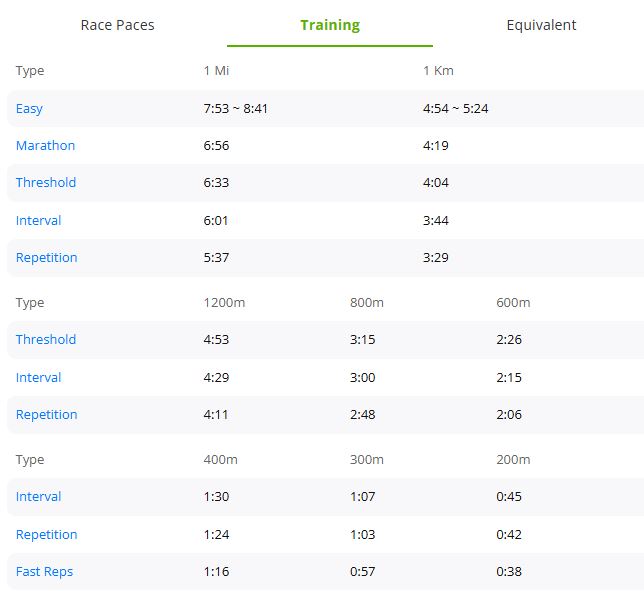
JD gives you five training paces to follow:
E – Easy
M – Marathon Pace
T – Threshold
I – Interval
R – Repetition
Throughout the training block JD purposefully has different phases with different paces included. For instance, in the peak phase, you will have M (marathon pace), T (threshold) , I (interval) , R (repetition) runs plus a Long Run with M or T segments built in.
Each pace is determined by your VDOT and each workout is a combination of the above paces.
Pfitzinger 18/55
18 week training block, peaking at 55 miles (88km).
Pfitz follows a traditional 2 workouts per week plus 1 long run philosophy. Or arguably, this type of structure has become tradition because of Pfitz!
Pfitz has a few different training plans:
18/55
12/55
18/70
12/70
18/85
18/107
The first number is the duration of the plan, so either a 12 week or 18 week plan.
The second number is the peaking mileage. 55 miles per week is no joke and not for the faint of heart!
As mentioned before, Pfitz plans are built around a mid-week MLR. Every marathon training plan has a long run of 18-22 miles. Pfitz Marathon plans have an additional 12-14 mile (19-23 km) MLR every single week at a pace slower than MP but faster than an easy pace, high end of zone 2. It does a great job of increasing fatigue in your legs week over week.
A second key difference with Pfitz plans is the pace that Pfitz distinguishes the easy (recovery) runs versus endurance runs. Not all runs outside of the MLR, LR, and Workouts are easy runs. Some are endurance runs that are at a comfortable pace but not so fast as Marathon Pace.
Comparing Plan Structure
Daniels
Quality workouts are the basis for the JD formula with building your own easy runs around them.
Sample Week:
Quality workout #1: 2E + 6M + 1E + 6M + 1E (16 miles)
Quality workout #2: 6E + 3T + 3 Min E + 2T + 2 min E + 1T + 2E (14 miles)
The rest of the days would be easy recovery days where you can dictate distance and pace.
Pfitzinger
Pfitz marathon plan typically follows the Easy, Hard, Easy, Hard pattern.
Sample Week:
Monday – Rest
Tuesday – 7 miles at Recovery pace with strides
Wednesday – 11 mile Threshold with 7 miles at 15k to HM pace
Thursday – Rest
Friday – 12 mile MLR
Saturday – 5 mile Recovery
Sunday – 20 mile LR
Within the Pfitz 18/55 and 18/70 plans, every 4 weeks there is a down week. He calls them micro phases. The idea is that you build up volume and intensity for a few weeks and then rest and allow time for your body to internalize the new physical peak.
Weekly Mileage and Intensity
Daniels
Daniels Running Formula is based around 2 quality workouts each week. The daunting part of this plan is that each workout is around 2 hours. It can be difficult to find the time to fit one of these workouts during your week.
Mileage is a bit more self coached with JD since the easy days don’t have specific distances to follow.
A good way to increase your mileage is to get comfortable with slowly increasing your easy days from 5 miles up to 10 miles.
Pfitzinger
There are two main marathon training plans that Pfitz has, one peaking at 55 miles (88kms) and one peaking at 70 miles (112 kms).
Depending on your schedule and how much volume you can handle will determine which plan you should choose.
Pfitz 18/55 starts with 33 miles as the first week building up over several weeks to 55 miles. Whereas the 18/70 plan starts at 54 miles and builds up from there.
You should be plenty comfortable with the mileage in the first week, it should actually be a bit less than what you have been running previously. Lets say you are gearing up for your Spring marathon, if over the winter you averaged 40 miles per week then jumping into pfitz 18/55 will be a reasonable progression. However going into 18/70 would be too big of a jump.
The intensity with Pfitz plans can be daunting since you have 3 workouts throughout the week. 1 V02 max or Threshold workout, 1 MLR, and 1 LR.
How Jack Daniels and Pfitzinger Approach Pacing for Marathon Training
Daniels
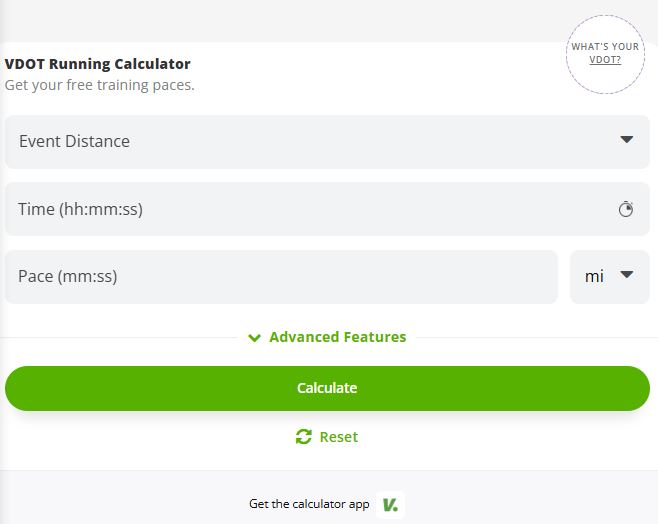
The VDOT calculator is what Jack Daniels uses to set pacing for each type of workout. It is a simple way to have exact pacing for every mile you run.
All you do is input either your goal race pace or a PR from a recent race and you can go from there.
Pfitzinger
Pfitz marathon plans base the running pace on % heart rate max as well as goal pace.
Recovery Runs:
60-70% of Heart Rate Max
General Aerobic Runs:
70-80% of Heart Rate Max
Tempo Runs:
80-90% of Heart Rate Max
Marathon Pace Runs:
75-85% of Heart Rate Max
The book goes into a few different ways of measuring max heart rate. Doing a field test is the best way for most runners as it doesn’t require special equipment.
How to do a Field Test for Max Heart Rate
- Warm up with light 10-15 easy jog or dynamic warmup
- Perform 3 intervals of 3-5 minutes at progressively faster paces. With 3 minutes of recovery between sets.
- After these intervals, push yourself as hard as possible for 2 minute all-out effort to maximize your heart rate.
- During the final effort, use a heart rate monitor to measure your highest heart rate. **note: wrist based heart rate monitors are not as accurate as arm band or chest straps
Which Plan Is Best Fit For You?
Daniels
Someone who can dedicate 2 hours on the weekend and 2 hours during a weekday for hard workouts.
You want to know exactly what paces you should be running each mile at.
Someone who can bounce back from not hitting hard workouts at proper paces.
You can recover from a hard mid week workout to hit the next one strong.
You can run speedwork on fatigued legs.
Pfitzinger
You want to build stamina through structure with specific daily distances and longer long runs
Have time for 2 weekday medium workouts and 1 weekend long run.
You value the progression of the long run distance and intensity.
Pros and Cons
| Pfitz 18/55 | JD 2Q | |
| Pros | 3 workouts per week Progressive long runs Long runs at Marathon Pace | Flexibility Demanding hardworkouts Simple pacing |
| Cons | Consistency of hitting your scheduled run every day Less time for strength training Challenging v02 max workouts | Quality workouts are long, hard finding time for 2 2-hour workouts Long runs arent long enough |
 Breaking 3
Leave a comment