When it comes to marathon training, the Long Run is the backbone of any training program. If you compare an advanced 5km training plan with an advanced marathon training plan, mileage will be very similar between the two. The two main differences will be the specific types of workouts and the Long Run.
A typical 12 to 18 week Marathon Build is about building Marathon specific adaptability. That is where the Long Run is key to build that specific adaptation in your body so that you can not just survive the Marathon and complete the distance but so that you can thrive and take your time down to reach the Boston Qualifier time plus cutoff.
Let’s dig into some of my favourite Long Run workouts as I’ve taken my Marathon time down from 4:45 hrs to 2:53.

Stop Doing Only Steady State Long Runs
In order to break the coveted 3 hour mark, no more easy long runs where you chill with an audiobook with heart rate at the low end of zone 2. It won’t get you there.
Pete Pfitzinger’s Advanced Marathoning popularized the idea of the Progression Run.
Jeff Cunningham has popularized the idea of interjecting different types of interval workouts within your Long Run.
Daniels Running Formula by Jack Daniels popularized the idea of having 2Q; 2 quality workouts a week within a Medium Long Run or Long Run.
Taggart VanEtten who you can find on X, and has a Marathon PB of 2:13:58 and is a running coach. Posts Long run examples on X every week.
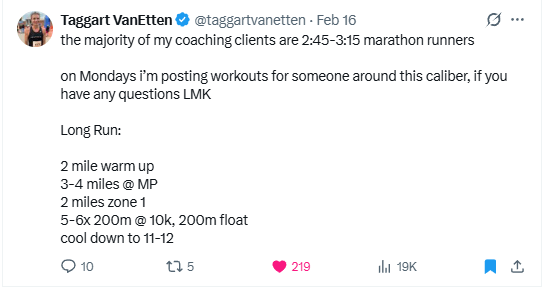
So why do we want to do Long Runs with mixed pacing instead of jogging an easy long run for 2 to 3 hours?
That may work great for your first Marathon, if you’re trying to complete the distance then the aerobic benefit will be enough for you.
If you’ve run a few Marathon’s and are going for a specific time, you’ve leveled up where it’s no longer about completing a distance but hitting a time goal or trying to break 3 hrs in the Marathon. Then this is one key way to level up your long run.
Steady state Long Runs don’t teach your body to push when the going gets tough. By adding in mixed pacing workouts within your Long Run it teaches your body to be able to push the pace even when your legs are tired, it’s not just about maintaining Marathon Pace for 42.2 kms but to hit it for the final 10km – 15kms.
I’ve found once you hit 27kms (17 miles) that is usually when the slog can happen in a Marathon. By practicing hitting faster than Marathon Pace at the end of a Long Run then it trains your body to be able to maintain strong from for the latter half of a Marathon.
Marathon Pace Specific Long Run
This is a classic. It’s the first rung up from the steady state long run. Pftiz marathon plans incorporate a few standard MP long runs.
In Pfitz Marathon plans, he commonly builds the Marathon Pace Long Run every 2-3 weeks.
8 miles at MP within a 16-17 mile LR
10 miles at MP within 17-18 mile LR
12 miles at MP within 17-18 mile LR
14 miles at MP within 20-21 mile LR
*18/85 plan
Pfitz recommends you warm up with ~6-7 easy miles and then do the MP section so that you are ending your run with the MP segment.
Being able to hit 12-14 miles at MP 4-6 weeks out from your Marathon is a real marker of fitness. You can build this within a Half Marathon Race if you’d like, to help facilitate the race day vibes. Or you can do it solo.
Float
Other MP long run sessions that are great for adaptability are adding in a Marathon Pace intervals with a float.
So a float is a “rest” period in an interval, however it is only about 5-10% slower than goal marathon pace. So you can ease off the pace temporarily, give your body a short break, while still maintaining some speed and intensity before you get back into the next MP interval.
This might look like:
3×3 mile (3x5km) at MP with ½ mile float or 1km float at 10% slower than MP.
So in total you get 9 miles (14-15kms) of Marathon specific work but it is more manageable than 9-10 straight miles at MP.
Doing MP with a float is great near the beginning of a Marathon Build.
Race Start Marathon Pace
Something I don’t see talked about online ever is starting a run without a warm up but going straight into your Marathon Pace.
Ie. 16 miles (26kms) at MP with no warmup or cooldown
This targets a system that we don’t think about, how quickly can your body get into Marathon zone and stay there? Come race day, we don’t want a long warm up before a race as you are just tiring out your body and depleting glycogen prematurely.
I like to do 1 Marathon Start Long Run within a marathon block, typically on the latter half of a block.

Fast Finish Long Run
Pfitz popularized the idea of a Progression Run. In Advanced Marathoning he recommends starting your run 20% slower at the start and then bringing it down to 10% slower than MP by the end.
Any run longer than 10 miles (16km) this can be applied to.
It captures the idea of controlled speed. Forcing your body to speed up over the course of the Long Run instead of slowing down from fatigue.
Over time I’ve noticed that I don’t even need to think about it anymore but my body will naturally speed up over the progress of a run.
Let’s say you are targeting a 2:52:30 marathon time. Marathon pace is 6:34/mile or 4:04/km. Starting the run at 7:50-8:00/mile (4:50-5:00/km) and then slowly and with purpose working your way down to 7:00 min/mile (4:25-4:30/km) by the end. I like to break it up into mini segments, every 3 miles up the pace for example.
If you run where it’s cold and are training for a spring marathon, that means treadmill running. This is a great way of adding some interest to a treadmill long run. Every 3 or 4 miles, increase the speed by 0.3 MPH.
Stacked Long Run
This is the crux of an advanced runners arsenal. Mixing in different modalities and zones into a Long Run will give you the greatest benefit to your neuromuscular fitness.
What is a Stacked Long Run?
A stacked Long Run is where you layer in multiple intensity zones into your long run. This is the most fun as it gives you a target always.
It emphasizes the progression of stimuli and really targets running fast when legs are fatigued.
We already talked about Marathon specific pace. With a stacked long run we want to add in a combination of MP + one of: HM pace, 10k pace, 5k pace.
You can really have fun coming up with different ways to do this.
Examples
Example 1:
3 mi WU
2 x (3 mi at MP, 1 mi at HMP) 1 mi Float
3 mi CD
16 miles total
Example 2:
3 mi WU
3 x 2 mi at HMP, 3 min easy jog rest
4 miles at 10% slower than MP
4 x 1k at 10k pace, 2 minute walk rest
2 mi CD
18 miles total
Example 3:
4-5 miles easy warm up
4 miles progressing down to MP
2 miles 10% slower than MP
6 x 400m at 10k pace, 200m float at MP -10%
2 mile CD
13 miles total
The possibilities with this type of framework and thought process are endless. You can be your own coach and have fun with it!
I particularly love the Stacked Long Run with treadmill running and it gives you something to work towards and the treadmill does the pacing for you.
You can also interject hills into your workouts for added strength training and stress.
Conclusion
Stacked long runs are one of the most effective marathon training tools for runners looking to break through performance plateaus and hit specific time goals. By combining marathon pace, half marathon pace, and faster intervals into a single session, this style of long run builds endurance, improves running economy, and trains your body to maintain speed under fatigue. Instead of relying on traditional steady-state long runs, incorporating structured, mixed-pace workouts allows you to simulate real race demands—especially in the critical final 10–15 kms of a marathon.
If your goal is to run faster, stronger, and more efficiently on race day, adding stacked long runs into your marathon training plan can provide a significant edge. Use them strategically, stay consistent, and you’ll develop the strength and resilience needed to perform when it matters most.
 Breaking 3
Leave a comment